
Table of Contents
If you are still assigning a virtual assistant to copy and paste business details from Google Maps, you are burning money. Manual data entry is dead. According to the latest research, 86% of users now use Google Maps specifically to find local stores and businesses. To tap this massive volume of intent, you need the top Google Maps scraper that doesn’t just “scrape” but actually thinks.
In this area of lead generation, the standard has shifted. Modern tools now use AI-driven cleaning to handle the messiest parts of the job. They don’t just pull a raw phone number; they verify if it’s active.
The best Google Maps scrapers in 2026 are faster and smarter because they adapt to Google’s changing layout in real-time. These tools use a strong approach to bypass anti-bot defenses smoothly. Also, they take advantage of natural language processing (NLP) to categorize leads by intent, not just by the industry tag they chose five years ago.
This guide looks at the current top performers to help you decide which one should power your next campaign.
How We Organize the List of Top Google Maps Scrapers
The Top Cloud-Based Scraping Tools for Mass Lead Generation
To find the right fit, we have categorized his year’s top performers into four distinct groups based on how they operate and who they are built for:
- Cloud-Based Tools: Best for marketers who want to set up a search and walk away. These tools run on the provider’s servers, meaning they operate 24/7, even if your computer is turned off.
- Desktop Software: Ideal for high-volume users who need deep customization and more control over the scraping workflow directly from their own machine.
- Browser Extensions: Perfect for solo recruiters or small business owners who need a quick, “point-and-click” way to grab data while browsing Google Maps.
- Developer’s Choice: These are API-first tools built for technical teams who need to integrate raw Google Maps data directly into their own custom software or internal databases.
Here are the ten tools leading the market in 2026:
- Outscraper (Cloud-Based/Developer’s Choice)
- Apify (Cloud-Based / Developer’s Choice)
- PhantomBuster (Cloud-Based)
- Lobstr.io (Cloud-Based)
- Octoparse (Desktop Software)
- Map Lead Scraper (Browser Extension)
- Maps Extractor (Browser Extension)
- ScrapingBee (Developer’s Choice)
- Bright Data (Developer’s Choice)
- ScraperAPI (Developer’s Choice)
Cloud-based tools are the best choice for mass lead generation because they run on external servers. This means you can extract thousands of leads without slowing down your computer or worrying about your IP being flagged.
| Tool | Best For | Type | Action |
|---|---|---|---|
| Outscraper | Best Overall | Cloud / API | View Deal → |
| Apify | Power Users | Cloud / Actors | Try Free → |
| PhantomBuster | Sales Auto | Cloud | Get Started → |
| Lobstr.io | Scheduling | Cloud | View Tool → |
| Octoparse | No-Code | Desktop | Download → |
| Map Lead Scraper | Quick Tasks | Extension | Add to Chrome → |
| G Maps Extractor | Deep Data | Extension | View More → |
| ScrapingBee | Developers | API | Get API Key → |
| Bright Data | Enterprise | Proxy / API | View Demo → |
| ScraperAPI | High Success | API | Start Free → |
1. Outscraper: The Best All-In-One Lead Extractor
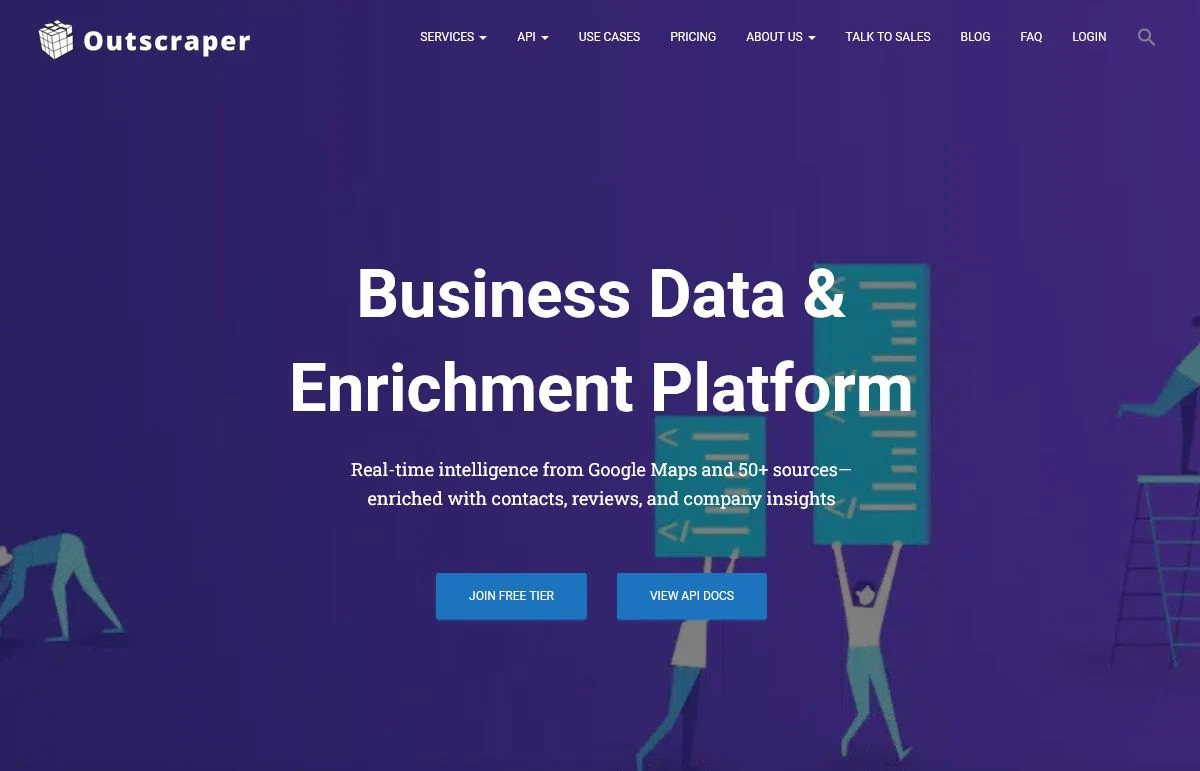
Outscraper has evolved into a complete business data and enrichment platform. It is a top-tier service for marketers who want a unified workflow that combines raw data extraction with lead validation.
The Pay-As-You-Go Advantage: Unlike services that lock you into monthly contracts, Outscraper uses a pay-as-you-go model. You only pay for the exact number of records you export, making it cost-effective for agencies with shifting needs.
Finding Niche Markets with “All Possible Categories”: To find leads that competitors miss, use all possible categories features. Instead of just searching for broad terms like “Restaurant,” this tool scans over 5,000 specific Google Maps categories. It automatically finds sub-niches like “Pizza Delivery” or “Catering Services” in your target area.
Building a Multi-Channel Sales Plan As an enrichment platform, Outscraper does more than just pull names. You can take advantage of its built-in services to find:
- Verified Emails: It scans business websites to find direct contact details.
- Social Media Links: It pulls profiles from Facebook, Instagram, and LinkedIn.
By gathering these details, you can build a sales plan that moves smoothly across multiple channels. Following up an email with a LinkedIn connection significantly increases your response rates.
Apify: The Power-User’s Choice for Custom Data
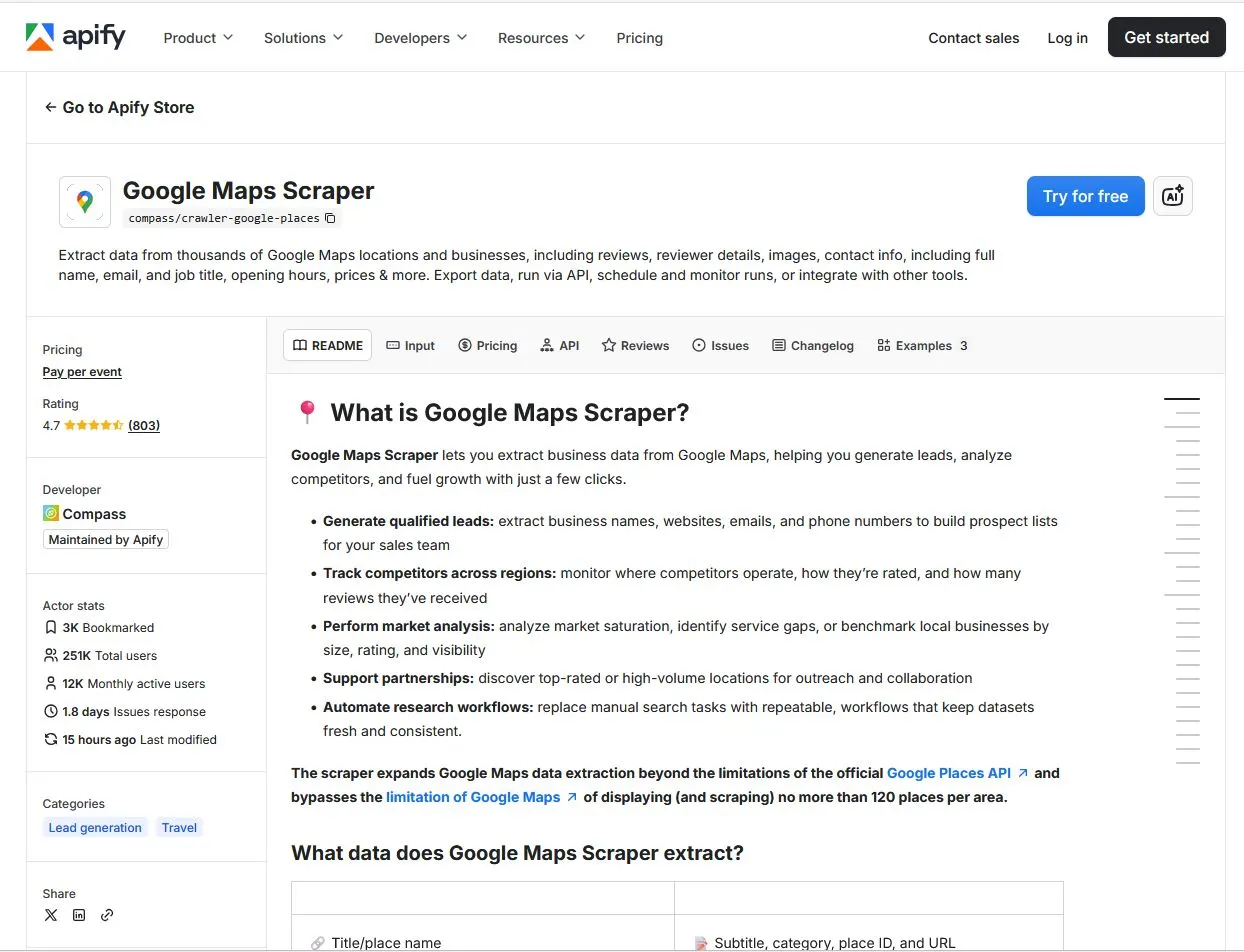
If you need more than just a list of names, Apify is the tool for you. It is built for teams that require deep, granular control over the data extraction process. Unlike simpler scrapers, Apify operates through “Actors.” These are specialized, cloud-based programs designed for specific tasks.
The Power of Specialized Actors: Apify’s Google Maps Scraper Actor is one of the most sophisticated in the market. It allows you to customize exactly what you want to extract, whether it’s business hours, detailed reviews, or even latitude and longitude coordinates.
Because these Actors are highly adaptable, they can bypass the usual 120-result limit that Google Maps imposes on a single search, helping you gather thousands of leads in one go.
Residential Proxies to Avoid Blocks: For power users, the biggest challenge is avoiding Google’s aggressive anti-bot defenses. Apify allows you to take advantage of residential proxies. These proxies route your requests through real home IP addresses rather than data centers, making your scraper look like a normal human user.
This approach ensures you get the most detailed data available without hitting a “search wall” or getting your IP flagged.
3. PhantomBuster: Best for Automated Sales Workflows
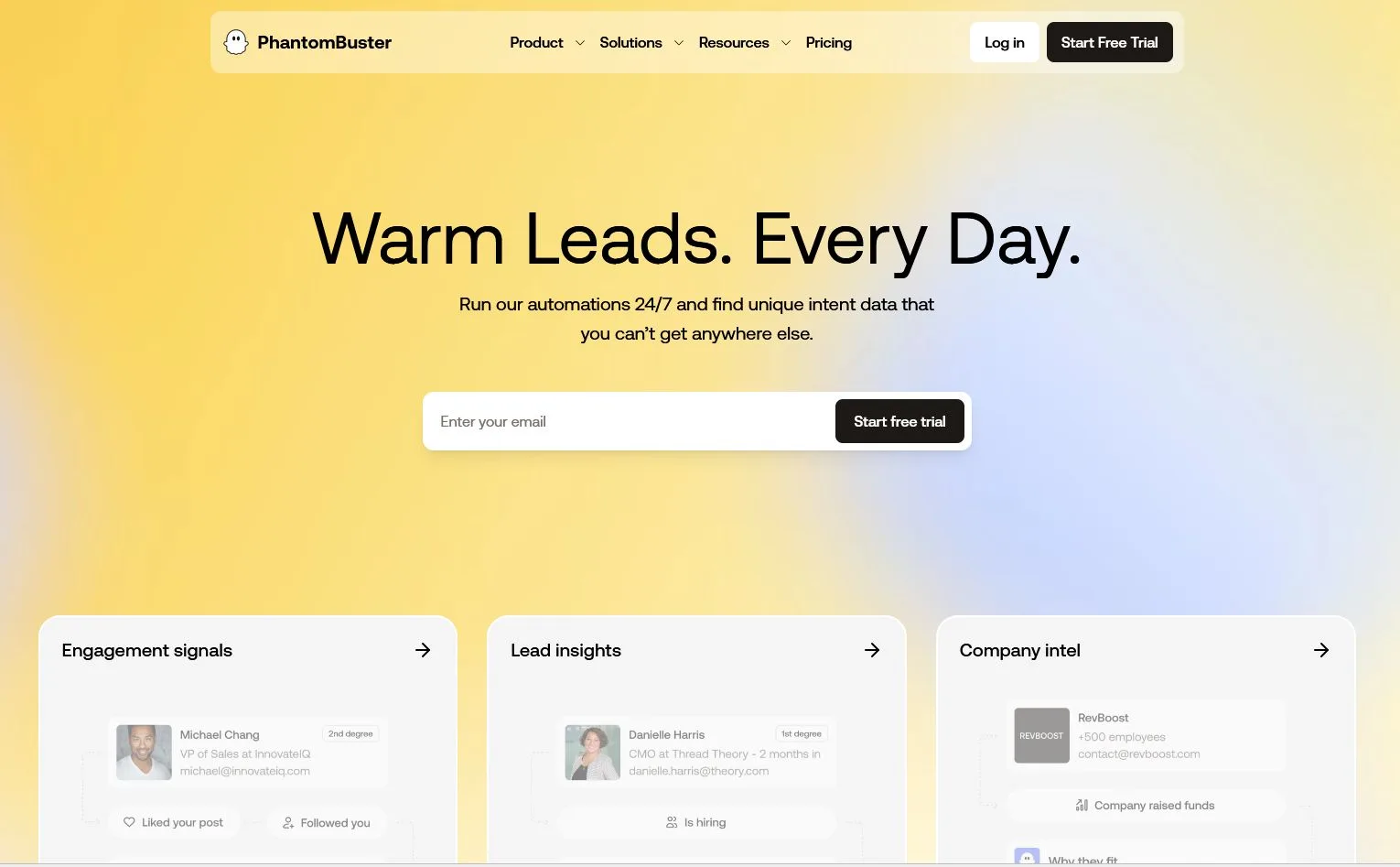
PhantomBuster is a favorite for agency owners because it doesn’t just find data; it acts on it. It is designed to be a “set and forget” tool that bridges the gap between Google Maps and social media.
With their automated workflows, you can take advantage of a multi-step sequence: first, the tool scrapes a list of businesses from Google Maps; then, it automatically finds the professional networking site’s profiles of the owners or managers; finally, it sends a personalized connection request.
By connecting these steps in a single cloud-based network, you can automate your entire top-of-funnel outreach while you focus on closing deals.
4. Lobstr.io: The Expert Choice for Scheduled Cloud Scraping
Lobstr.io is a powerful, no-code cloud platform that focuses on “industrial-scale” data collection without the need for a developer. It is particularly popular in 2026 for its reliability and its clean, modern interface.
Automated “Squids” for 24/7 Scraping: On this platform, you don’t just run a one-off search. You set up what they call “Squids,” which are automated scraping bots that live in the cloud. You can schedule these bots to run every day, week, or month.
This is perfect for marketing agencies that need to monitor new business openings in a specific city. Once a new listing appears on Google Maps, Lobstr.io picks it up automatically.
Taking Advantage of Native Integrations: One of the biggest benefits of Lobstr.io is how it handles your data after the scrape. You can take advantage of its native integrations to send your leads directly to Google Sheets, Amazon S3, or an SFTP server.
It moves data smoothly from the web to your internal database without you ever having to download a file. Also, it features a strong built-in proxy management system, so you never have to worry about getting blocked by Google while your Squids are working.
Desktop Software and Browser Extensions for Quick Tasks
While cloud tools handle massive, scheduled crawls, sometimes you need a faster way to grab data while you work. Desktop software and browser extensions provide a more visual way to manage your scraping without leaving your research window.
5. Octoparse: The Best No-Code Visual Scraper
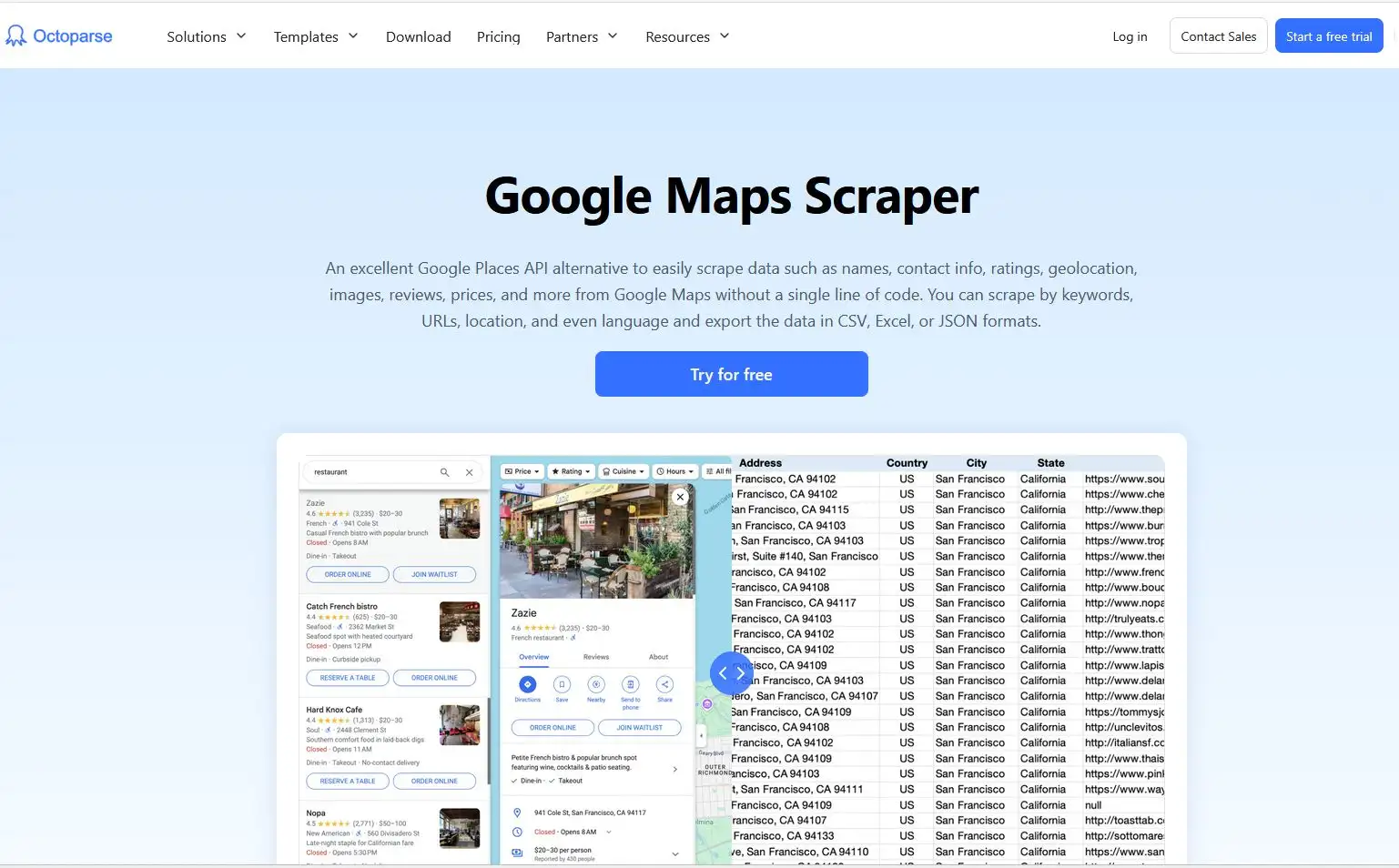
Octoparse is a powerhouse for non-coders who want a custom-built crawler without writing a single line of code. In 2026, it updated its pre-built Google Maps templates, making it easier than ever to start a scrape.
This tool uses a visual “point-and-click” interface. If you can see the data on your screen, you can scrape it. It’s ideal for building a stable, repeatable crawler that can handle dynamic elements like infinite scrolling and pop-up windows.
With its strong anti-blocking features and scheduled cloud runs, you can set your scraping pattern once and let it collect fresh leads on autopilot every week.
6. Map Lead Scraper: The Go-To Chrome Extension
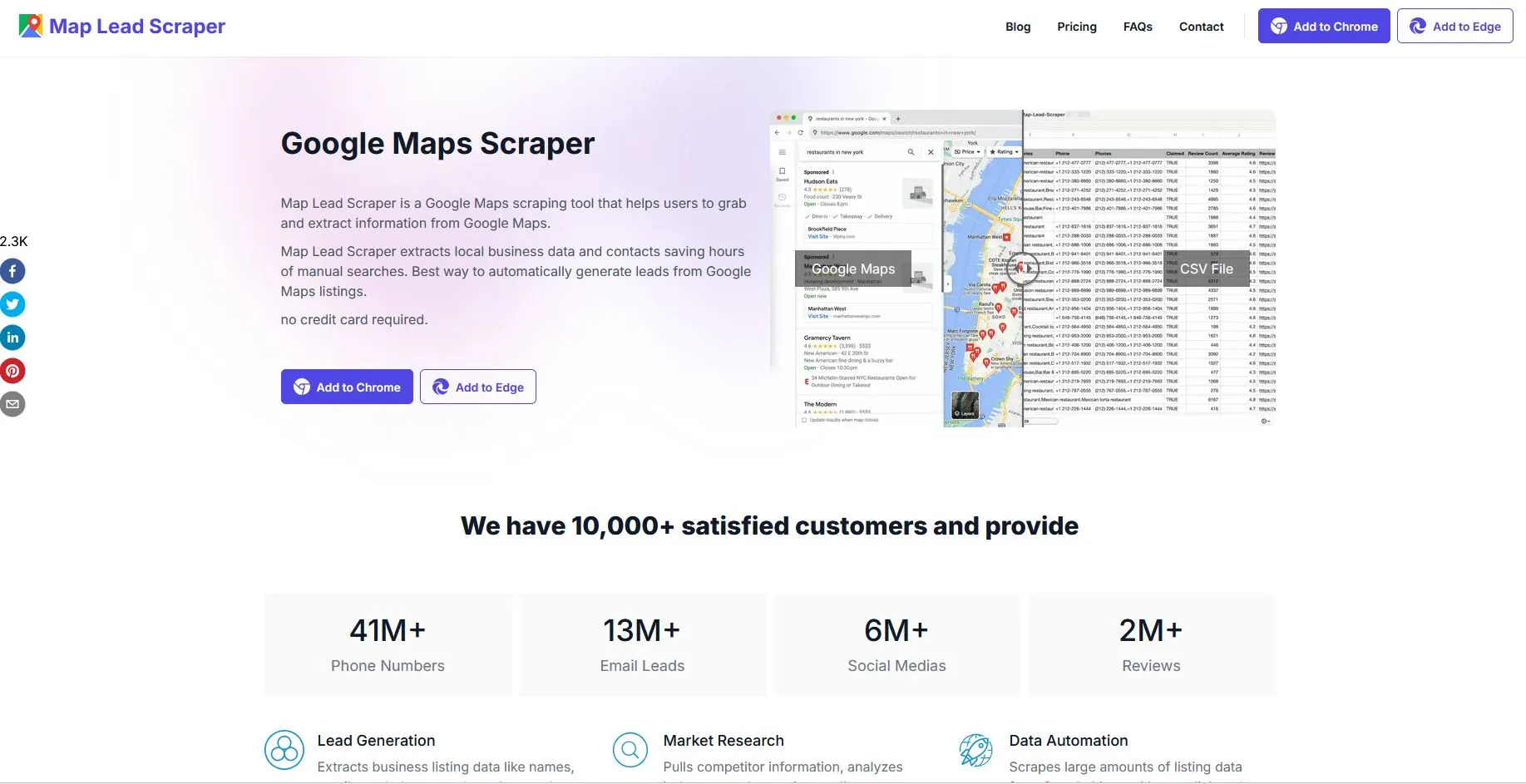
If you are looking for a reliable Google Maps scraper extension, this tool is the top choice for 2026. It is built for users who want a simple, “one-click” way to pull data without setting up complex workflows or API keys.
As you browse Google Maps, the extension sits in your sidebar, ready to extract over 100 leads directly from your current search results. It’s perfect for solo founders or local recruiters who need to build a targeted list in minutes.
You simply run your search, hit the “start” button, and download your results as a clean CSV or Excel file. It even handles the background scrolling for you to ensure you get every listing on the page.
7. G Maps Extractor: The Deep Data Specialist
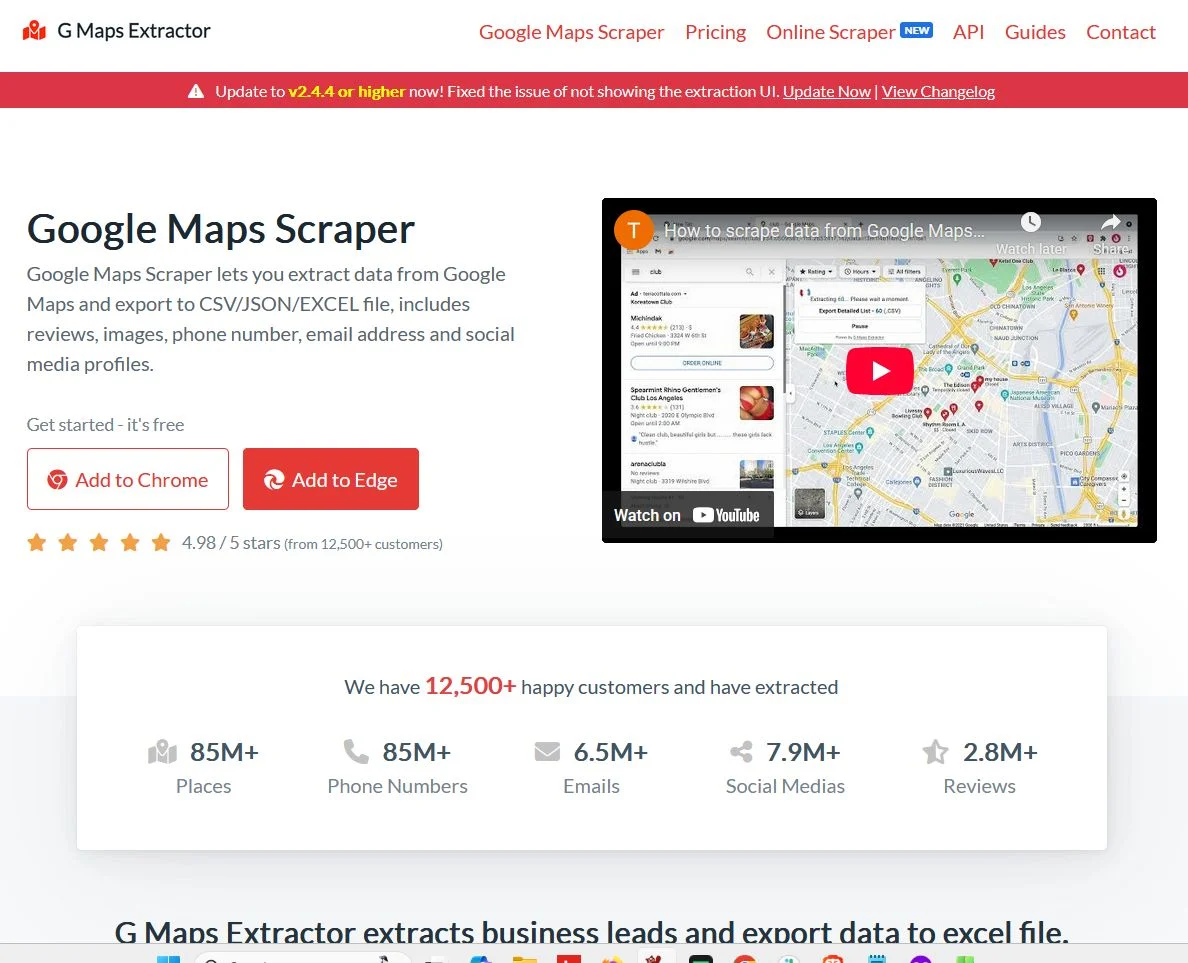
G Maps Extractor stands out by capturing the technical data points that most basic scrapers miss. It is a specialist tool for marketers who need a deeper understanding of the businesses they are targeting.
Beyond just names and phone numbers, this tool allows you to pull Place IDs, specific business hours, and even review sentiment. By gathering Place IDs, you can easily sync your data with other Google APIs or CRM systems.
Also, you can take advantage of its review analysis features to filter businesses by customer satisfaction. This helps you build a more personalized sales pitch by identifying companies with poor ratings that might need your reputation management or marketing services.
High-Volume Tools for Enterprise and Advanced Users
When your lead generation goals scale into the thousands or millions, basic extensions won’t cut it. Enterprise-grade tools are designed to handle massive data requests while staying invisible to anti-bot systems. These services focus on speed, reliability, and deep integration into your existing sales tech stack.
8. ScrapingBee: The Best API for Developers
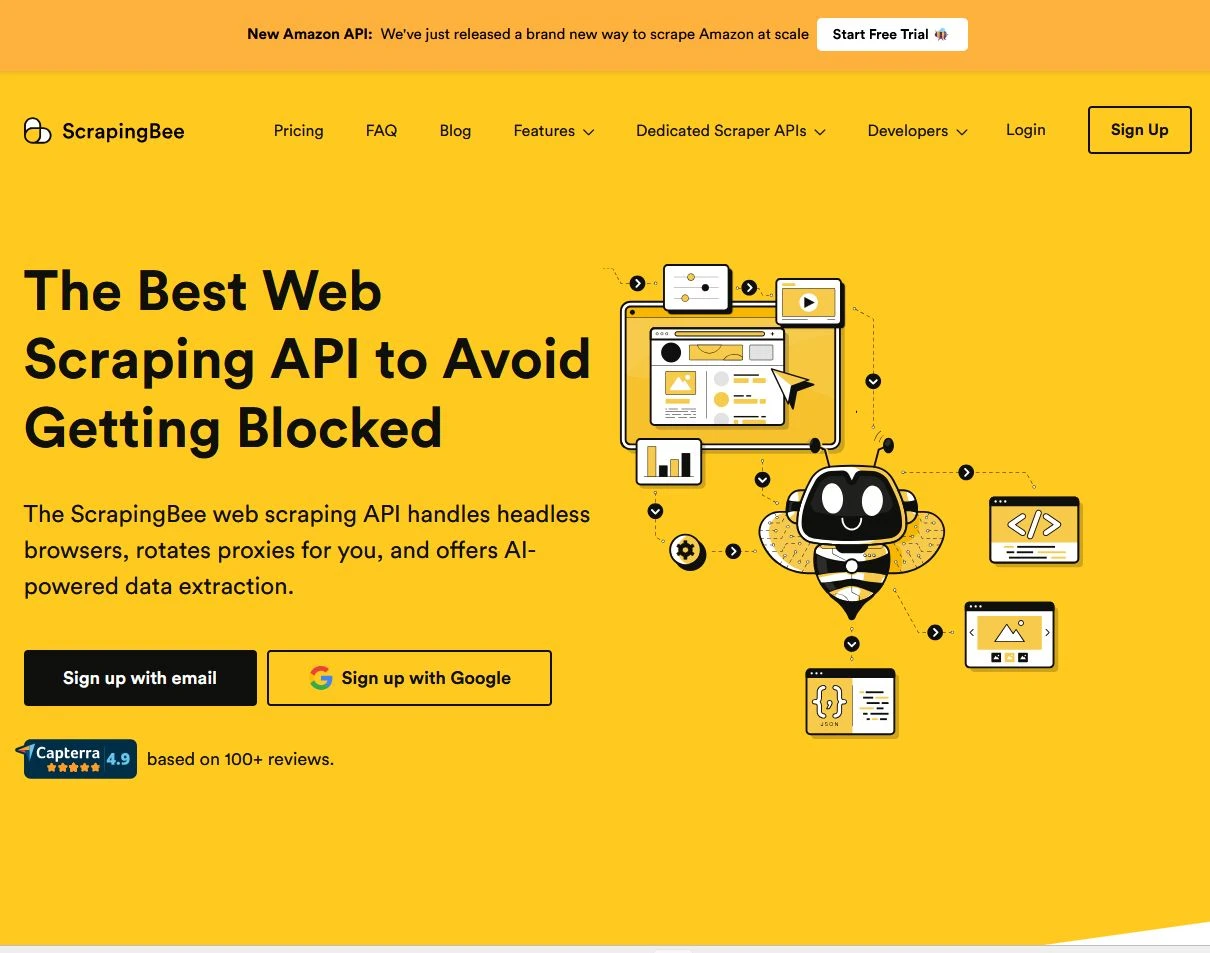
ScrapingBee is designed for technical teams who don’t want to build a scraping infrastructure from scratch. They take a “we-handle-the-nasty-bits” approach, which means they deal with the messy backend work so your developers can focus on building your actual product.
Simple API Calls, Structured JSON: The beauty of ScrapingBee is its simplicity. Instead of managing a browser or writing complex scripts to navigate the Google Maps interface, you send a simple API call.
ScrapingBee renders the page in a headless browser, extracts the relevant fields, and returns everything as structured JSON. This data is ready to be plugged directly into your CRM or custom dashboard immediately.
No More CAPTCHAs: One of the most frustrating parts of scraping is solving CAPTCHAs. ScrapingBee manages this automatically. Their advanced system handles proxy rotation and CAPTCHA solving behind the scenes. Also, because they use real Chrome instances to render pages, the data you receive is exactly what a human would see, ensuring your lead lists are always accurate and up to date.
9. Bright Data: The Most Reliable Proxy-Based Scraping
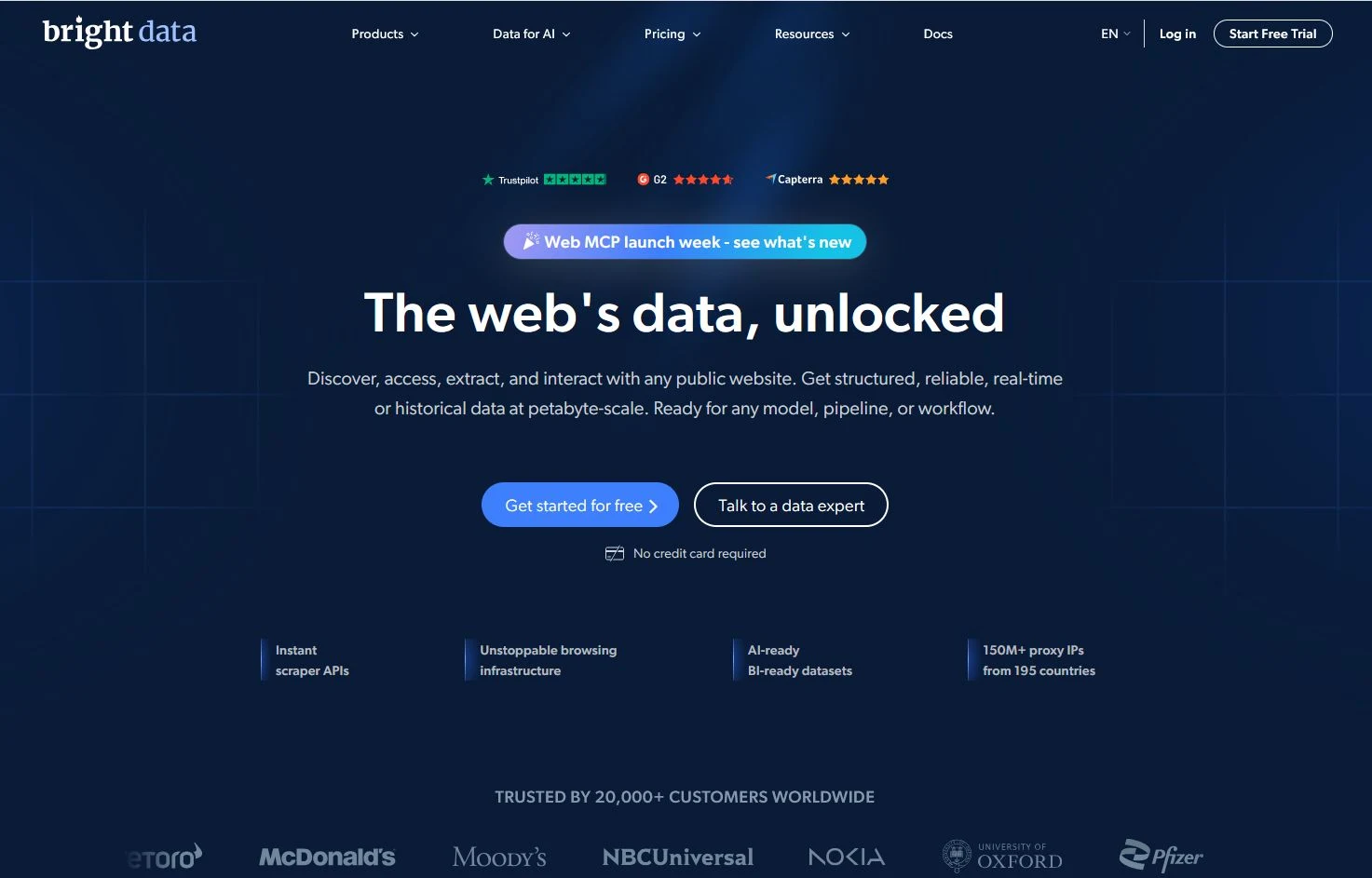
Bright Data is the heavy hitter for those who need to extract millions of records without downtime. It is less of a simple scraper and more of a massive data infrastructure.
The core of their success in 2026 is their advanced unblocking technology. While basic scrapers get caught by CAPTCHAs, Bright Data uses a smooth approach that mimics real human behavior across a network of 150 million residential IPs.
This means the scraper looks like a real person browsing from a home WiFi connection in a specific city. This level of stealth helps enterprises collect the most detailed business data globally without the risk of being blocked or receiving inaccurate, geo-restricted results.
10. ScraperAPI: The Most Reliable Choice for High-Success Rates

ScraperAPI is a favorite for developers who want to take advantage of a “proxy-first” approach. It is built for those who have experienced constant blocks or CAPTCHAs with other tools and need a service that simply works every time.
Handling the Technical Hurdles: The biggest draw of ScraperAPI is its internal rotation logic. When you send a request to Google Maps, the API automatically rotates through millions of proxies and manages browser headers to ensure your request looks like a legitimate user.
It handles retries automatically, so if a request fails, it tries again with a different configuration until it succeeds. This helps you maintain a nearly 100% success rate even when scraping thousands of listings.
Customizable Geolocation: For local lead generation, accuracy is everything. ScraperAPI allows you to specify exactly where your request should come from. If you are scraping businesses in London, you can route your request through a London-based IP address.
This ensures that the results you see are identical to what a local user would find. Also, it renders all JavaScript smoothly, meaning you get all the dynamic content like reviews and photos that basic HTML scrapers often miss.
How to Examine and Choose the Right Tool for Your Niche
Choosing a scraper depends entirely on the volume of data you need and how you plan to use it. A local business owner has very different requirements than a software founder scaling a global sales team.
For Local Realtors and Small Businesses
If you are a real estate agent or a small business owner, your goal is usually quality over quantity. You don’t need millions of records; you need 50 to 100 highly relevant leads in a specific ZIP code.
For these low-volume, high-relevance searches, browser extensions like Map Lead Scraper or G Maps Extractor are the best choice. They allow you to stay within the Google Maps interface while you work. You can manually filter the search results and only hit “export” when you see a list of businesses that fit your criteria.
This approach keeps your data clean and prevents you from paying for thousands of irrelevant leads that don’t fit your local territory.
For SaaS Founders and Marketing Agencies
Marketing agencies and SaaS teams operate on a different scale. You need a constant stream of fresh data to feed your outbound sales engine. For this level of work, you should look toward cloud tools or APIs like Outscraper, Apify, or ScrapingBee.
These services are built to handle bulk enrichment, such as finding the verified email of a CEO or the LinkedIn profile of a marketing manager. Also, they offer strong integration options. You can take advantage of API keys or webhooks to sync your scraped data smoothly with CRMs like HubSpot, Pipedrive, or Salesforce.
This automation ensures that your sales team always has a fresh list of prospects to call without you ever having to manually upload a CSV file. By using these advanced services, you can build a lead generation machine that runs in the background while you focus on closing high-value accounts.
Conclusion
Building a lead generation engine in 2026 requires more than just a list of business names. It requires clean, enriched, and actionable data that moves your sales process forward. Whether you are a solo realtor looking for local prospects or a SaaS founder scaling a global outreach campaign, the right tool is the one that fits into your existing workflow without creating more manual work.
The industry has moved past simple data extraction. Today, the most successful marketers use services that verify contact details and categorize intent automatically. By choosing a tool that aligns with your technical ability and volume needs, you can stop hunting for data and start closing more deals.
The Definitive Winner for 2026
After comparing the top players in the market, here is our direct verdict for the three best paths forward:
- The Easiest Experience: Outscraper. It is the best all-in-one business data and enrichment platform for most marketers. Its pay-as-you-go model and built-in email finder make it the most user-friendly choice for high-quality leads.
- The Most Powerful: Apify. For teams that need deep, custom data and granular control, Apify’s “Actors” are unmatched. It is the best choice for overcoming complex technical hurdles and getting the most detailed results.
- The Best for Developers: ScrapingBee. If you are building your own tools and want a simple API that handles the “nasty bits” of proxies and CAPTCHAs, this is your winner.
Frequently Asked Questions (FAQ)
Outscraper is the top choice because it includes built-in website enrichment to find verified business emails automatically.
Many tools like Apify and Outscraper offer free tiers or trial credits that allow you to test their services before paying.
Extensions work in your browser for quick tasks, while cloud scrapers run on external servers to handle mass lead generation 24/7.
No, tools like Outscraper, Octoparse, and Map Lead Scraper are designed with visual interfaces specifically for non-technical users.
Yes, but using a professional tool with residential proxies or built-in rotation helps you bypass defenses smoothly and safely.